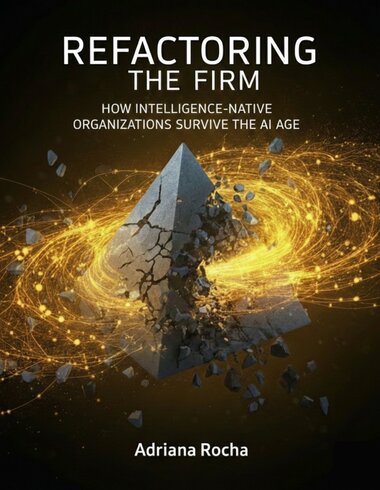
Now Available on Amazon

Refactoring
the Firm

How Intelligence-Native Organizations Survive the AI Age

By Adriana Rocha

Your organization was designed for an era that no longer exists. This is not a manifesto on culture — it is a migration guide for leaders ready to rebuild for the age of AI.

Refactoring the Firm
The Diagnosis
THE OLD STRUCTURES ARE DISSOLVING.
“You cannot run 21st-century fluid intelligence on 19th-century solid infrastructure. For a hundred years, we built organizations like cathedrals: solid, hierarchical, and immovable. But today, the environment is accelerating. When a solid structure meets a fluid environment, it doesn’t bend. It cracks.”
Leaders are patching these cracks with AI tools — ignoring the fundamental failure of system architecture.
Adding AI to a bureaucracy doesn’t give you speed. It just gives you a faster mess.
Why This Book Exists

I was the bottleneck. This book is the architecture I built to solve it.

In late 2025, I was building a new ecosystem of startups and found myself trapped in the very pattern this book diagnoses. Coordinating teams across three continents, multiple time zones, dozens of parallel workstreams — and every decision routed through me. I was experiencing in real time the organizational friction that AI was supposed to eliminate but hadn't.

The INO framework was born to solve my own problem first. But the insight didn't come from nowhere — it came from 25 years of building intelligent systems at scale, and the convergence of three fields I had studied deeply: Collective Intelligence (MIT/Malone), Software Architecture, and Agentic AI.

This book is not an academic exercise. Every concept has a concrete implementation. Every chapter maps to a deployable feature. The same framework that lives in these pages is the operating system I am building at Wortya — the first organization designed to run on its own intelligent infrastructure.

Three Bodies of Knowledge
01
Collective Intelligence
MIT Media Lab / Thomas W. Malone — how groups of humans and machines act together more intelligently than any individual alone.
02
Software Architecture
Domain-Driven Design, Microservices, the Strangler Pattern — applied to organizational design instead of code.
03
Agentic AI Systems
Multi-agent coordination, constitutional governance, the Model Context Protocol — the new substrate of organizational intelligence.
⚡
The book is the blueprint. INO-OS is the implementation.
intelligencenative.ai →
Inside the Book

22 Chapters. Five Parts. One Blueprint.

From diagnosis to architecture to your first 90 days — a complete guide to building organizations where humans and AI thrive together.

Click any chapter to see what it covers.

Part IThe Diagnosis
1The Melt Begins›
2The End of the Solid Age›
3From Nouns to Verbs›
4The Friction of Disconnection›
Part IIThe New Architecture
5The Constitution of the INO›
6The Symbiotic Web›
7The Digital Twin›
8The Customer Node›
9The Continuous Pulse›
10Purpose as the Attraction›
NEWThe Outcome›
11The Intelligent Artifact›
12Workflows›
13The OFI›
Part IIILeadership & Migration
14The Architecture of Attraction›
15The Economy of Flow›
16Leadership in the INO›
Part IVEvolution
17The Missing Substrate›
18The Strangler Pattern›
19The Three-Year Journey›
Part VThe Human Element
20The Human Side of Refactoring›
21The Personal Transformation›
22The INO Playbook›
Interlude — From the Book

The Seven Fears

Every leader who considers this transition faces the same seven objections. The book addresses each one directly. Click any fear to see the answer.

01
"If we dissolve the hierarchy, won't we lose control?"
+
02
"Won't a Permeable Edge leak our intellectual property?"
+
03
"Will AI Agents replace my human workforce?"
+
04
"How do we maintain culture in a distributed, fluid mesh?"
+
05
"Is this model only for software or tech companies?"
+
06
"Won't managers resist losing their gatekeeping power?"
+
07
"Isn't it safer to wait until the technology matures?"
+
The Vocabulary

Six Concepts That Will Reframe How You Think About Organizations

Each of these terms represents a chapter — and a deployable architectural pattern.

INO
Intelligence-Native Organization
An organization where AI agents are constitutional citizens — not tools — operating with rights, obligations, and governance. Structure follows strategy in real time.
OFI
Organizational Fluidity Index
The EBITDA of Adaptability. A quantitative score measuring your firm's capacity to learn faster than its environment is changing. Formula: (Plasticity × Permeability × Agentic Density) / Decision Latency.
INA
Intelligence-Native Artifact
The atomic unit of work. A smart, self-routing object with four layers: Payload (the deliverable), Context (the why), Ledger (the audit trail), and Routing (where it goes next). Work that moves itself.
Digital Twin
Your AI Proxy
A personal AI trained on your decisions, communication patterns, and values. It acts on your behalf while you sleep, across time zones, in parallel workstreams — with a constitutional obligation to stay aligned to you.
Neural Mesh
The Living Org Chart
The dynamic, self-organizing network of humans and agents that replaces the static org chart. Connections form and dissolve around work, not around job titles. The organization as a living system.
BYOT
Bring Your Own Twin
The future of employment: professionals arrive at new organizations with their pre-trained Digital Twin as a portable personal asset. Ten times faster onboarding. The IP you take with you when you leave.
Want the full vocabulary?Explore all 20+ INO terms in our Glossary →
The INO Framework

A complete architecture in five layers

Every layer is defined in the book — and every layer is a deployable module in the Wortya OS.

1
Constitution
Encodes human rights and accountability into the architecture itself. Freedom without constitutional guardrails is chaos — this layer ensures AI and humans operate within a governance structure that cannot be overridden.
2
Flow Layer
Replaces rigid processes with living workflows that route intelligently. Three archetypes: Pipeline, Decision Tree, and Mesh — each matched to different types of organizational work.
3
Object Layer
Work is no longer a task assigned to a person. It is a smart object that carries its own context, tracks its own ledger, and routes itself to the next capable node — human or agent.
4
Twin Layer
Every human node has an AI proxy trained on their decisions and values. Specialist agents handle domain tasks. Together they create a network that processes value 24 hours a day, 7 days a week, across every time zone.
5
Telemetry
The nervous system of the INO. Real-time measurement of organizational fluidity, decision latency, and outcome velocity. The OFI gives you a single number for how well your firm is learning to adapt.
From the Book

Three sentences that tell the whole story

“
When a solid structure meets a fluid environment, it doesn’t bend. It cracks. You feel these cracks every day: the decision latency, the meeting fatigue, the silos that trap data.
Part I — The Diagnosis
“
Adding AI to a bureaucracy doesn’t give you speed. It just gives you a faster mess. The failure is not technological. It is architectural.
Introduction — The Fatal Error: Adding AI to a Cage
“
The question is not whether to adapt. The question is whether you will lead the change — or be changed by it.
Back Cover
Adriana Rocha
MIT xPRO Credential →
About the Author

Adriana Rocha

Systems engineer, serial entrepreneur, and CEO of Wortya. This book was not written from an ivory tower — it was forged from a pain I lived firsthand.

In late 2025, building a new ecosystem of startups, I found myself trapped in the very pattern this book diagnoses: I was the bottleneck. Coordinating teams across three continents, multiple time zones, dozens of parallel workstreams — and every decision routed through me. I was the mid-node router that Chapter 1 describes, experiencing in real time the organizational friction that AI was supposed to eliminate but hadn't. The INO framework was born to solve my own problem first.

But the insight didn't come from nowhere. I've spent 25+ years building systems — literally. As a computer engineer with an MBA in Marketing and Communications, I've built complete ERPs for agency management, media intelligence platforms using ML algorithms for investment prediction and optimization (since the 1990s), market research automation systems covering everything from questionnaire design to analytics generation, and community platforms used by the world's largest brands. I've lived inside hierarchies of 300 people operating nationally, and hierarchies of 30,000. I've been the startup founder in the chaos phase, the operator scaling across continents, and the architect redesigning from scratch.

All of that converges here. The INO framework is what happens when a systems engineer who has built intelligent systems for three decades meets the organizational dysfunction of the AI age — and refuses to accept it.

Systems EngineerMBA Marketing & CommunicationsMIT xPROESOMAR AI Task Force3 Continents25+ Years
Free Assessment

Where does your organization stand?

10 questions. 3 minutes. A clear diagnosis of whether your organization is still operating on industrial logic — or evolving toward an Intelligence-Native architecture.

Take the INO Readiness Test →

Free. No signup required to start.

0–3Industrial Organization
4–7Digital Organization
8–10Emerging INO Architecture
Ready to go deeper?Read our deep-dive articles on INO frameworks →
Stay in the Loop

Get INO insights from Adriana — new frameworks, case studies, and updates on the Intelligence-Native OS being built at Wortya.

No spam. Occasional insights and updates only.

Or get it now on Amazon →
Refactoring the Firm — Community

A community for the leaders building INOs

Connect with executives, transformation leads, and practitioners navigating the AI era. Ask questions, share results, and help shape what comes next.

Join the Community →

Free for readers of Refactoring the Firm.